
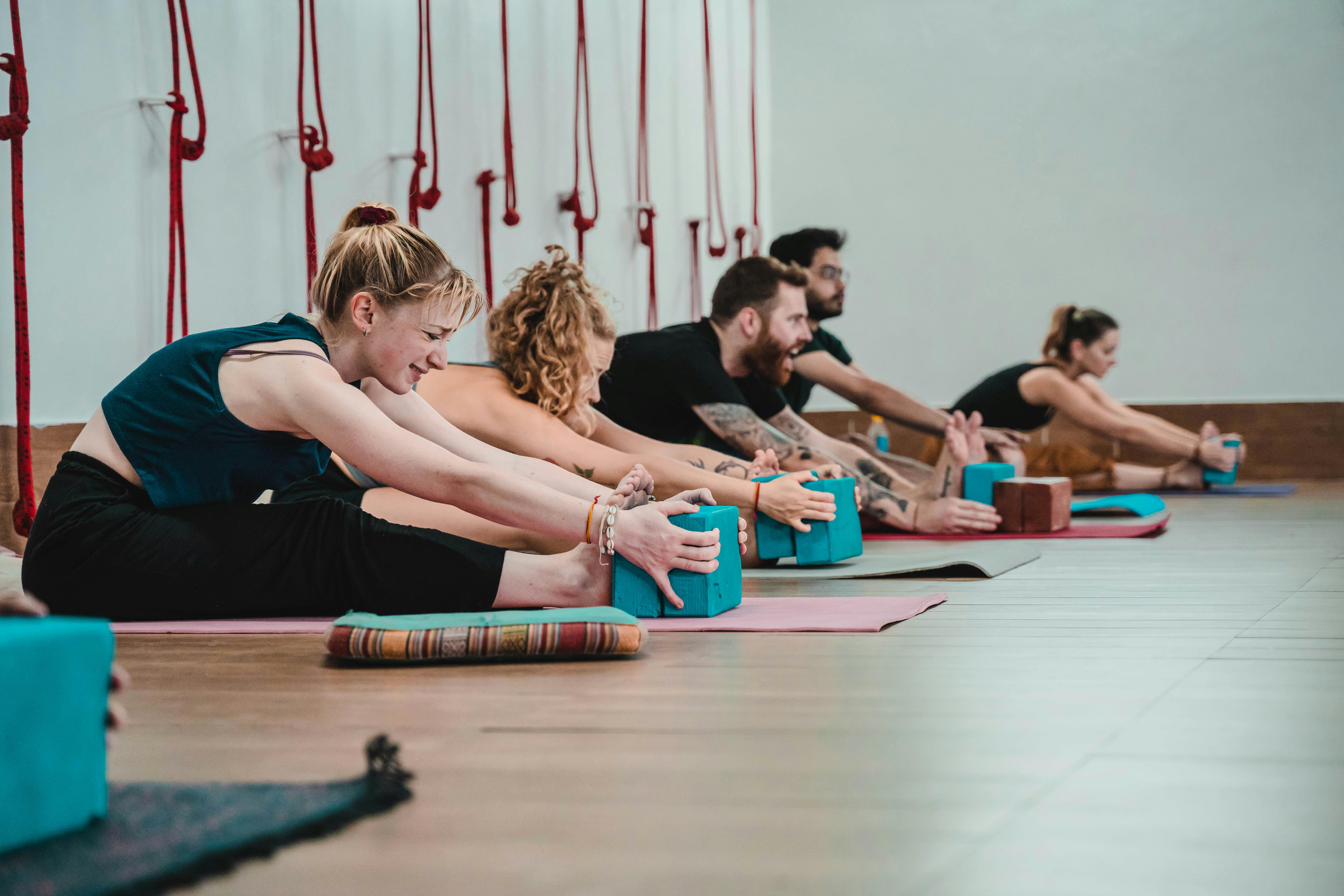
Yoga teachers give the breath more attention than the shapes, which puzzles students who came for the physical practice. The breath is doing several concrete jobs, none of them decorative.
It sets the pace of the practice
Linking each movement to an inhale or an exhale fixes the tempo to something that cannot be rushed without becoming obvious.
A student moving faster than their breath allows will begin holding it, and the holding is immediately audible to a teacher and noticeable to the student.
The breath therefore functions as a governor on effort, which matters in a practice with no external load to limit how hard someone works.
It reports on effort honestly
Breathing becomes ragged before most people acknowledge that a posture is beyond them, since the physical strain is easier to override than the respiratory one.
Teachers use this as a criterion, and the standard instruction to come out of a shape when the breath cannot stay smooth is a way of setting intensity from the inside.
It also removes the comparison with other students, since the limit is defined by the practitioner's own respiration rather than by the shape achieved.
Breathing muscles are postural muscles
The diaphragm attaches to the lower ribs and the lumbar spine, and it works alongside the deep abdominal and pelvic floor muscles that stabilise the trunk.
Those muscles have to coordinate both stabilising and breathing at once, and holding the breath is the simplest way to stabilise, which is why untrained students do it under load.
Training the ability to maintain steady breathing while the trunk is working is therefore a genuine motor skill rather than an atmospheric instruction.
It provides a continuous attentional anchor
The breath is always present, changes constantly and requires no equipment, which makes it the most convenient object of attention available.
Instructing students to follow it keeps attention in the room rather than on the day, which is what distinguishes a yoga class from a stretching session.
This is also the bridge to seated practice, since the anchor used through the physical practice is the same one used afterwards.
Formal breath practice is a separate discipline
Structured breathing techniques with specific ratios and retentions are a distinct branch of the tradition, taught in stages and traditionally with individual supervision.
These are more physiologically potent than simple breath awareness, and forceful or prolonged retention practices can provoke dizziness and, in some people, more significant effects.
Which is why they are usually introduced later than the postures, and why anyone with a cardiovascular or respiratory condition, or who is pregnant, should take them up only under experienced instruction.